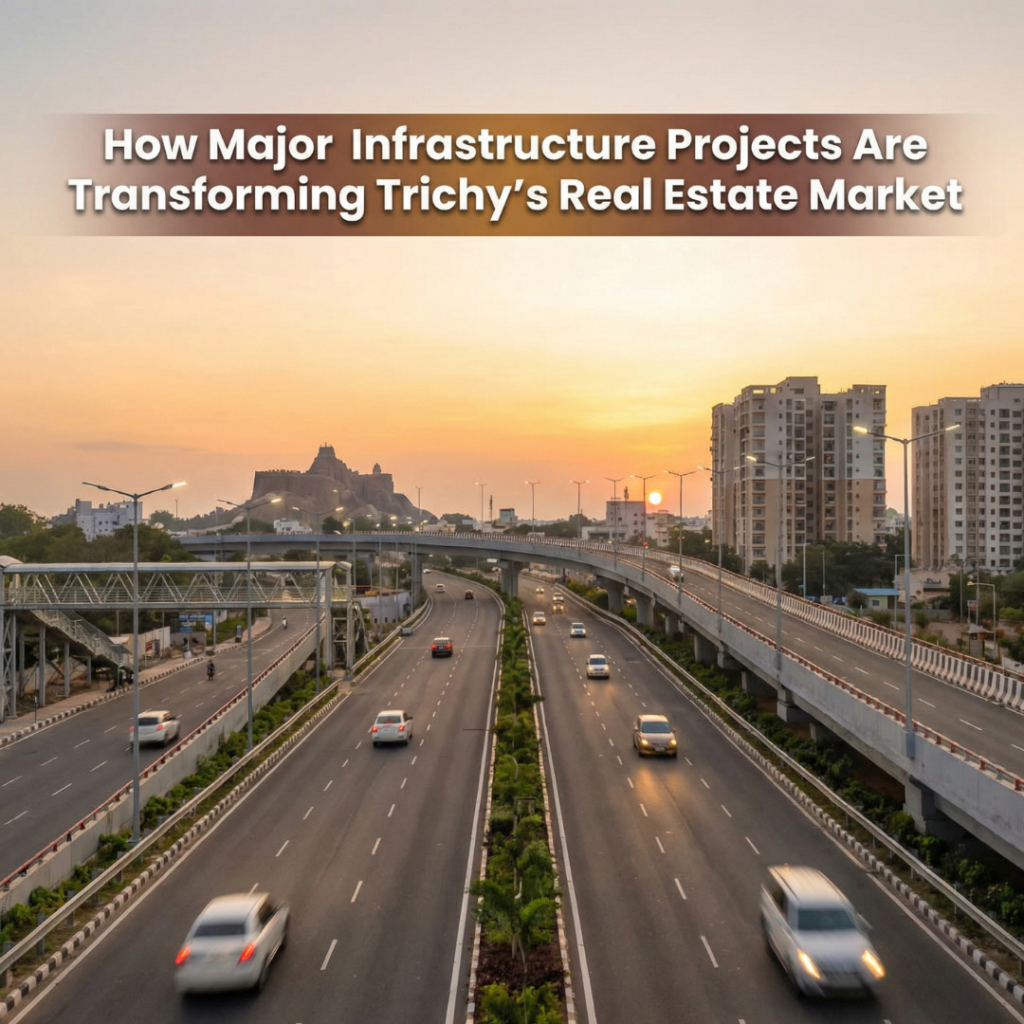
Trichy – officially Tiruchirappalli – is witnessing a transformative period in its urban development story. Once celebrated primarily for its cultural heritage, educational institutions, and central location in Tamil Nadu, the city is now rapidly emerging as one of the most promising real estate investment hubs in southern India. This transformation is being driven largely by a convergence of major infrastructure projects — from transportation and connectivity upgrades to economic accelerators like IT parks and smart city initiatives.
In this detailed analysis, we explore how projects such as the Integrated Bus Terminal (IBT), airport expansion, smart city initiatives, and other key developments are reshaping Trichy’s property landscape — influencing property values, demand dynamics, and investor sentiment.
1. Integrated Bus Terminal (IBT) at Panjapur: Reshaping Connectivity and Local Growth
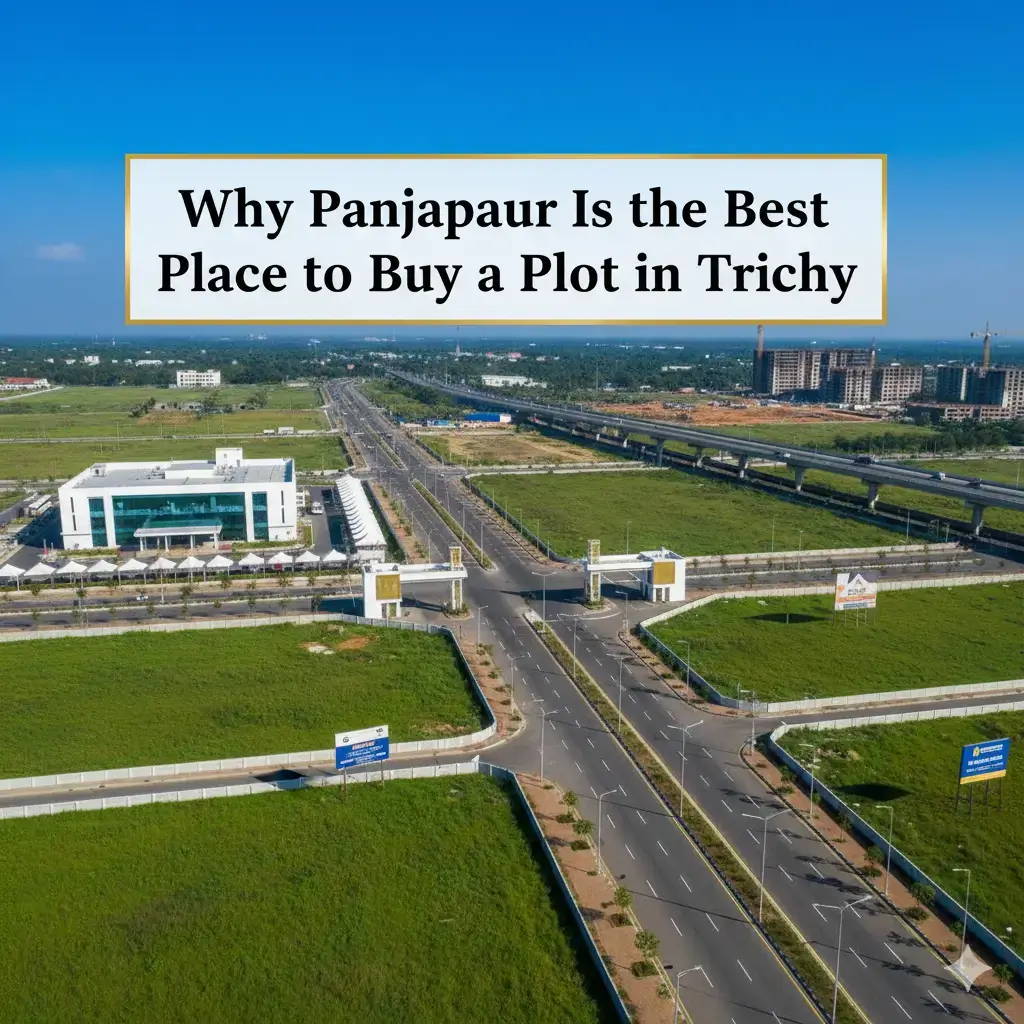
One of the most significant developments catalyzing change in Trichy’s real estate market is the Panjapur Integrated Bus Terminal (IBT). With an investment valued at around ₹360 crore, this state‑of‑the‑art facility is designed to handle long‑distance, interstate, and local buses, positioning itself as one of Tamil Nadu’s premier transit hubs.
The IBT’s strategic location along the Trichy–Madurai National Highway has major implications:
- Enhanced Connectivity: The bus terminal serves as a convergence point for travelers from across the state, drastically upgrading mobility for both residents and visitors.
- Decongested City Core: By shifting long‑distance buses away from the inner city, traffic pressure on central areas has eased — improving the appeal of residential neighbourhoods that were previously crowded.
- Real Estate Uplift: Areas around Panjapur, Kallikudi, and Lalgudi have seen land and property values appreciating as developers eye opportunities in these emerging corridors.
This connectivity upgrade has encouraged mixed‑use developments, with residential complexes, commercial hubs, retail centres, and logistics services sprouting around the IBT. Even land values alone in these zones have jumped significantly — with reported increases of around 20% in recent years.
2. Trichy International Airport Expansion: Global Connectivity and Premium Demand
Another major catalyst for Trichy’s market growth is the ongoing expansion of Trichy International Airport. The airport’s new terminal has been operational since June 2024, and there are plans to extend the runway and expand cargo operations — facilitating larger wide‑body aircraft and enhanced global connectivity.
Key impacts include:
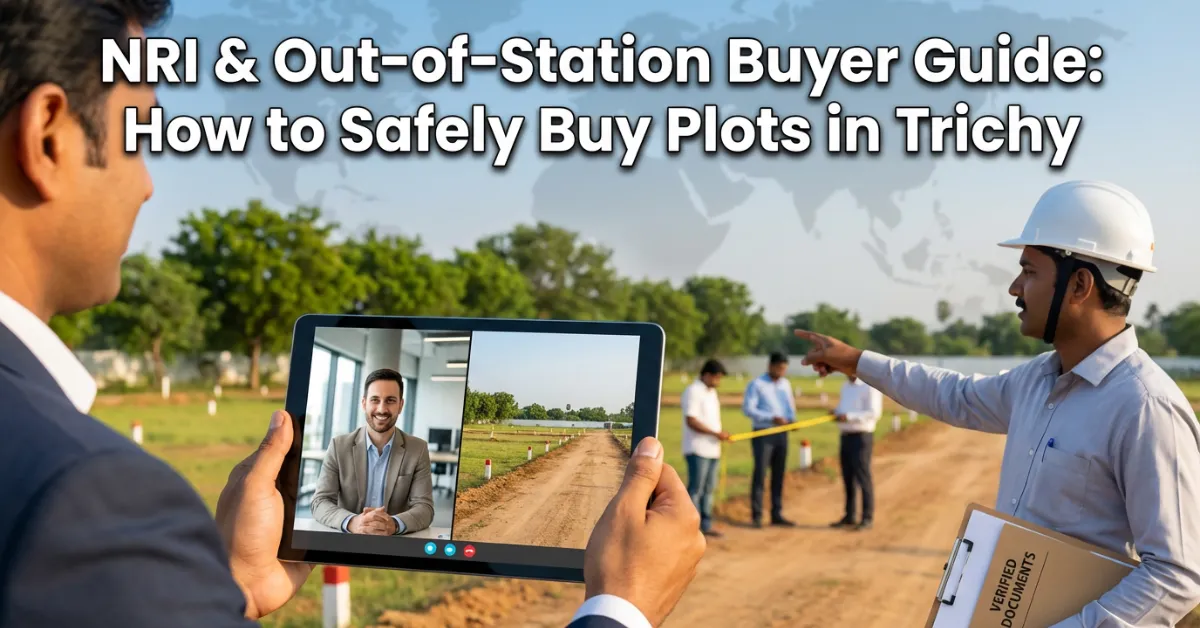
- NRI Interest: Improved international connectivity has made Trichy more attractive to non‑resident Indians (NRIs) and overseas investors looking for housing and commercial assets.
- Premium Housing Uptick: Localities such as KK Nagar, Thillai Nagar, Cantonment, and Srirangam have seen stronger demand for high‑end apartments and ready‑to‑move properties, with rental yields reported in the range of 6–7%.
- Business Accommodation Growth: With better air links, professionals and corporate travellers are pushing demand for serviced apartments and business hotels near the airport and city centre.
The airport’s growth narrative reinforces Trichy’s profile not just as a cultural hub, but as a nationally connected urban centre — a factor that often drives long‑term investment decisions in real estate.
3. Road Infrastructure and Ring Road Projects: Unlocking Suburban Potential
Exceptional road infrastructure is a common driver of real estate transformation across global cities, and Trichy’s story is no different. Several major roadway initiatives are reshaping both accessibility and land value patterns:
Semi‑Ring Road Project
The Trichy Semi‑Ring Road — designed to connect five national highways — is unlocking huge swathes of previously peripheral land for development.
Peripheral Growth: Suburban localities along this ring are attracting residential layouts, logistics hubs, and integrated townships.
Land Price Premium: Estimates suggest land values could grow by 30–35% in areas directly connected by the ring road by 2027.
Panjapur IBT Link Road
Work on a 9.9 km link road to connect the Panjapur IBT with major city arteries is underway, including elevated sections to overcome land acquisition challenges.
This type of connectivity overhaul is pivotal in transforming peripheral zones into mainstream neighbourhoods — often the first sign of next‑tier investment corridors in expanding cities.
4. TIDEL Park & IT Infrastructure: Driving Demand for Residential and Commercial Spaces
Economic anchors like IT parks are core drivers of real estate demand. In Trichy, the upcoming TIDEL Park is poised to be a major growth engine. This project will significantly expand the city’s technology infrastructure, creating space for thousands of professionals and positioning Trichy as a serious contender in Tamil Nadu’s IT landscape.
Why This Matters for Real Estate:
Job Creation: By bringing in major IT employment, the park is fueling demand for nearby housing — particularly for mid‑to‑high end apartments and rental units.
Commercial Expansion: Office space, co‑working centres, cafes, and retail services are springing up around the IT corridor.
Urban Ecosystem Growth: Cities with strong technology employment clusters often see higher property appreciation, driven by stable demand from professionals seeking proximity to workplaces.
In addition to TIDEL Park, other industrial projects such as growth in Thiruverumbur SIPCOT industrial park add an economic layer that increases overall homebuying confidence.
5. Smart City Initiatives: Enhancing Livability and Urban Services
Trichy’s inclusion in India’s Smart Cities Mission has injected a spirited focus on urban management and quality of life. While some smart city components are still in various stages, initiatives typically include:
- Better street lighting
- Intelligent traffic systems
- Improved public amenities
- Upgraded public spaces and parks
Though implementation has faced challenges, these efforts contribute to a cityscape that’s increasingly attractive for long-term residents and investors alike — especially as demand shifts toward livable, well‑managed urban environments.
6. Impact on Property Values — Present and Future Trajectory
Taken together, Trichy’s infrastructure momentum is reshaping real estate fundamentals:
Upsurge in Property Prices
Across many localities — from established zones like Thillai Nagar to emerging corridors like Panjapur and Thiruverumbur — property prices have witnessed significant upward movement. Market data indicates:
- Appreciations of up to 20–50% in land values over recent years.
- Growth in demand for larger units (3BHKs and above) reflecting quality‑of‑life and hybrid working preferences.
Shift in Buyer Profiles
Investors are no longer limited to local buyers. A rising proportion of demand comes from:
- NRIs
- Professionals relocating from other Indian cities
- Local end‑users seeking modern homes with superior lifestyle amenities
This diversified demand base typically signals stability and resilience in property markets, as dependence on any single segment (e.g., speculators) diminishes.
Rental Market Strength
With infrastructure enhancements attracting talent and travelers alike, rental markets — especially near employment hubs and transit corridors — have grown more robust, delivering stable yields for investors.
7. Emerging Investment Corridors Within Trichy
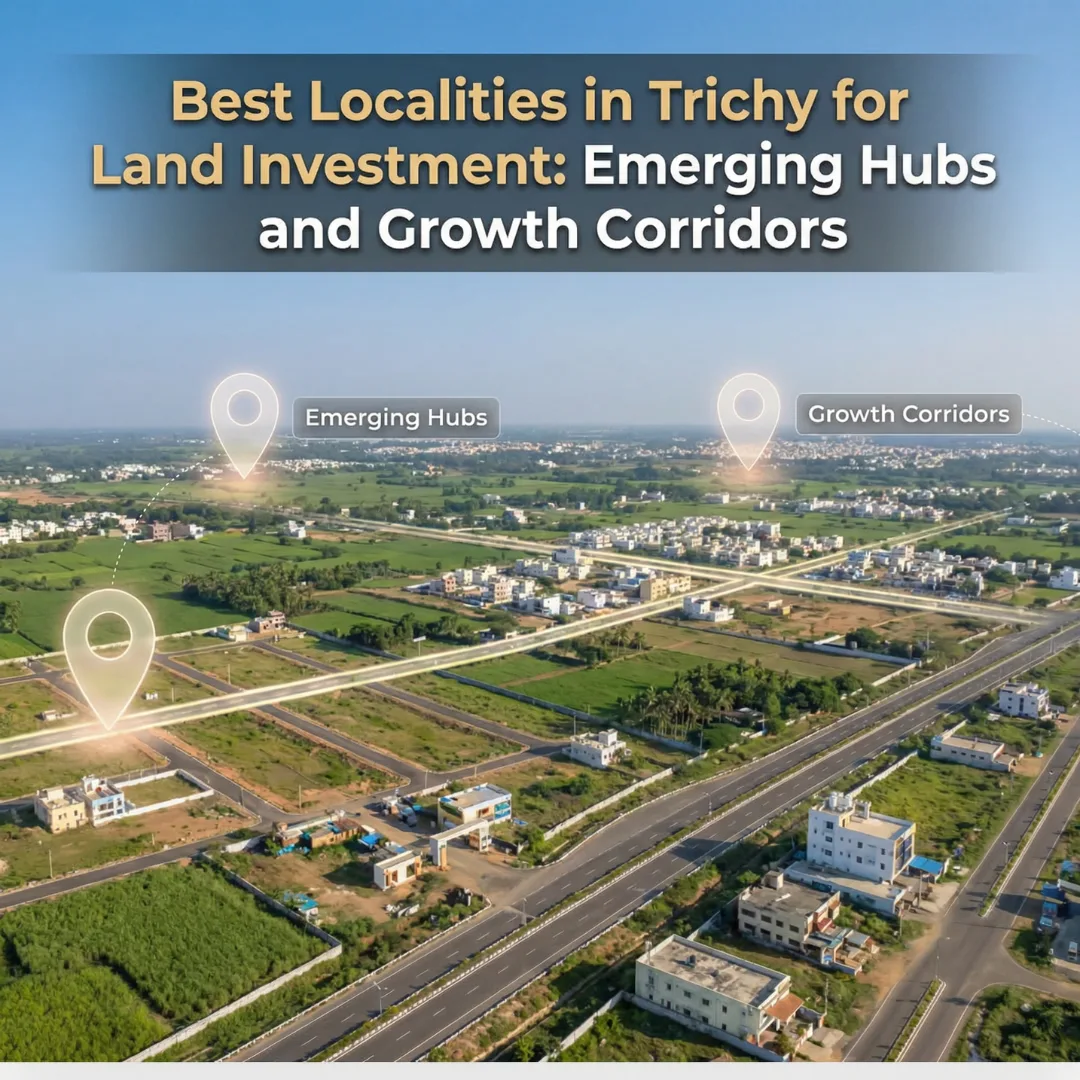
As a result of these strategic upgrades, certain localities within Trichy are now standout investment zones. Areas like Panjapur, Thillai Nagar, KK Nagar, Thiruverumbur, and Kallikudi are experiencing rapid development. Proximity to transit hubs, airport connectivity, IT parks, and industrial zones has made these neighbourhoods particularly appealing for both residential and commercial real estate. Investors are increasingly focusing on these emerging corridors for long-term capital appreciation.
Conclusion
Trichy’s real estate market is in the midst of a structural transformation — propelled by large-scale infrastructure projects that are redefining how people live, work, and invest in the city. From upgraded transit systems like the IBT to airport enhancements, road networks, economic accelerators like IT and industrial parks, and smart city frameworks, these developments are not just improving mobility and services — they are reshaping real estate demand and value creation.
For investors and buyers, understanding these infrastructure impacts is crucial for identifying opportunities and timing investments wisely. In the years ahead, Trichy’s metamorphosis is likely to continue — reinforcing its reputation as one of Tamil Nadu’s most compelling property markets.
How much have property prices risen in Trichy due to infrastructure projects?
Property prices have risen significantly in many parts of Trichy — with land values near major infrastructure corridors registering 20% or more growth in recent years, and broader market indicators showing up to 50% growth in certain segments.
Which Trichy localities are most impacted by infrastructure developments?
Areas like Panjapur, Thillai Nagar, KK Nagar, Thiruverumbur, and Kallikudi are reporting noticeable price growth due to proximity to the bus terminal, airport, industrial parks, and road upgrades.
Will the smart city projects add value to real estate despite implementation delays?
Yes. While some initiatives have faced execution challenges, smart city programs improve civic services and livability — factors that enhance long‑term value for investors and residents alike.
How does the airport expansion impact real estate demand?
The airport expansion has boosted demand for premium homes and rental accommodations, especially from NRIs and professionals who value enhanced air connectivity.
Is Trichy a good destination for long‑term property investment?
Yes. With multi‑pronged infrastructure development, improving quality of life, diversified employment opportunities, and steady price appreciation, Trichy offers strong long‑term fundamentals for real estate investment.